Real-Time Tracking: 7 Benefits for Your Delivery Fleet
Drafted with AI assistance and published by the Locate2u Editorial Team. See our editorial policy.

Most articles about delivery fleet tracking list benefits in the abstract: efficiency, visibility, customer satisfaction. Those are real, but they are hard to picture.
A clearer way to see the value is to follow a normal delivery day from the first job to the last report. Each part of the day uses live location in a different way.
Say you run eight vans out of one depot. Here are seven ways real-time GPS tracking changes that day, in the order you would notice them.
1. Dispatch starts with facts, not phone calls
The day starts with a question: who is where, and who can take what? Without tracking, dispatchers answer it by calling drivers one by one.
With a live map, every vehicle is already plotted, with color-coded status showing who is on route, idle, stopped or behind schedule. That makes it easy to slot an urgent pickup into the right run.
It also helps when the plan changes mid-morning. A dispatch tool such as Locate2u's dispatch planning software can auto-assign jobs based on driver proximity, vehicle capacity and availability, so the nearest suitable driver gets the new stop.
2. Customers get live ETAs without calling you
Once vans are on the road, the phone starts ringing. Most of those calls are the same question: when will my delivery arrive?
Live tracking answers it before it is asked. Each delivery can generate a tracking link sent by SMS or email, showing the driver's position and an ETA that counts down as they get closer.
Customers can plan around the delivery, and your team gets time back. Our guide on how to send customers a live tracking link covers the setup in detail.
3. Every drop has proof attached
A delivery is not finished when the parcel leaves the van. It is finished when you can prove it arrived.
Tracking adds a location and time to every stop. Combined with proof of delivery, drivers capture signatures and photos that are timestamped and geotagged, then synced straight to the office.
Franz Building Supplies paired live tracking links with photo proof of delivery, and its case study reports that customer delivery disputes dropped to nearly zero. If you want to tighten up how drivers capture proof, see our best practices for reliable proof of delivery.
4. Exceptions show up while you can still fix them
Every delivery day has problems: a road closure, a customer who is not home, a job that takes twice as long as planned. The difference tracking makes is when you find out.
Without it, you hear about a late run when the customer complains. With it, a vehicle marked behind schedule on the map is a prompt to act while there is still time.
That might mean moving a stop to another driver, warning the next customers or rescheduling a failed delivery. Geofence alerts help too, telling you when a vehicle arrives at or leaves a site without anyone needing to check in.
Exceptions are where most of a dispatcher's day goes. Seeing them early turns firefighting into routine adjustments.
5. Safer driving becomes something you can measure
Delivery work puts drivers under time pressure, and time pressure leads to speeding and harsh braking. Tracking makes that behavior visible.
Speed alerts flag drivers who exceed thresholds you set. Locate2u's fleet management software also logs harsh braking and rapid acceleration, and turns them into driver scorecards you can use for coaching.
The aim is not to catch people out. It is to spot risky patterns, often caused by unrealistic schedules, and fix them before someone gets hurt. Our post on improving driver safety through fleet management goes further into this.
Tracking also helps the driver directly. If a van breaks down or a driver stops responding, the office knows exactly where they are.
6. Hours and timesheets are easier to check
At the end of the day, someone has to sign off hours. Paper timesheets and memory leave room for honest mistakes and the occasional dispute.
Trip reports give you an objective record: time on the road, stops visited, distance traveled and idle duration for each vehicle. You can export them as PDF or CSV and compare them with submitted hours before payroll runs.
This works both ways. A driver who stayed late to finish a difficult run has the data to show it. Being open with drivers about what is recorded, and why, is what keeps this fair. We discuss that balance in how GPS tracking affects employee accountability.
7. Tomorrow's plan learns from today's history
Once the vans are back, the day's tracking data becomes a planning tool. Route playback lets you replay any vehicle's day and see where time actually went.
Look for patterns rather than single bad days. Maybe one customer always takes far longer than planned. Maybe one suburb is consistently slow at a certain hour. Maybe a run that looks efficient on paper spends a lot of time idling at the depot.
Performance reports on on-time delivery, distance and cost per delivery help you see which changes are working. One measure worth adding is stops per driver hour, which shows how productive each run really is.
Feed what you learn back into your route plans, and the next day starts from a better baseline.
Getting the most from tracking
A few habits make the difference between a map nobody looks at and a tool the whole team relies on:
- Send tracking links automatically. Do not wait for customers to ask.
- Agree on what counts as an exception. Decide how late is late, and who acts on it.
- Explain the system to drivers. Tell them what is tracked, when and why, and show them how it protects them.
- Review history weekly. Set aside time to look at playback and reports, not only the live map.
- Keep proof and tracking together. A dispute is easiest to settle when location, time, photo and signature sit in one record.
Getting full value from tracking
Real-time tracking is easy to think of as a map in the office. In practice, it touches every part of a delivery fleet's day: how jobs are assigned, how customers are kept informed, how disputes are settled, how drivers are kept safe and how tomorrow is planned.
The fleets that get the most from it are the ones that use the data at each of those points, not just when something goes wrong.
To see live tracking across your own fleet's day, from dispatch to proof of delivery, request access to Locate2u.

Related Articles
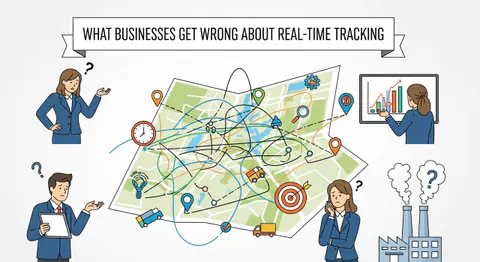
Real-Time Tracking Myths That Hold Fleets Back
Three real-time tracking myths debunked: that it is surveillance, too costly to set up, or unreliable, plus a practical plan to roll tracking out to your fleet.
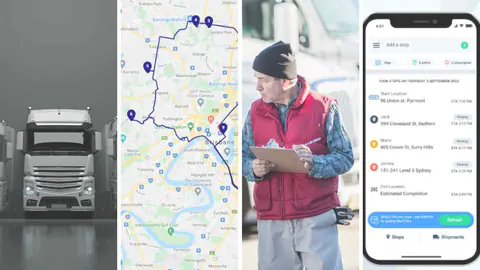
8 Ways to Cut Fleet Maintenance Costs
Eight ways fleet management software cuts maintenance costs, from predictive maintenance alerts and route optimization to driver monitoring and training.
5 Ways Fleet Management Software Cuts Fuel Use
How fleet management software improves fuel efficiency through smarter routes, driver behavior coaching, less idling, preventative maintenance and telematics.