DJI FlyCart 30 Explained: Specs, Modes, Price and Drone Rules
Drafted with AI assistance and published by the Locate2u Editorial Team. See our editorial policy.
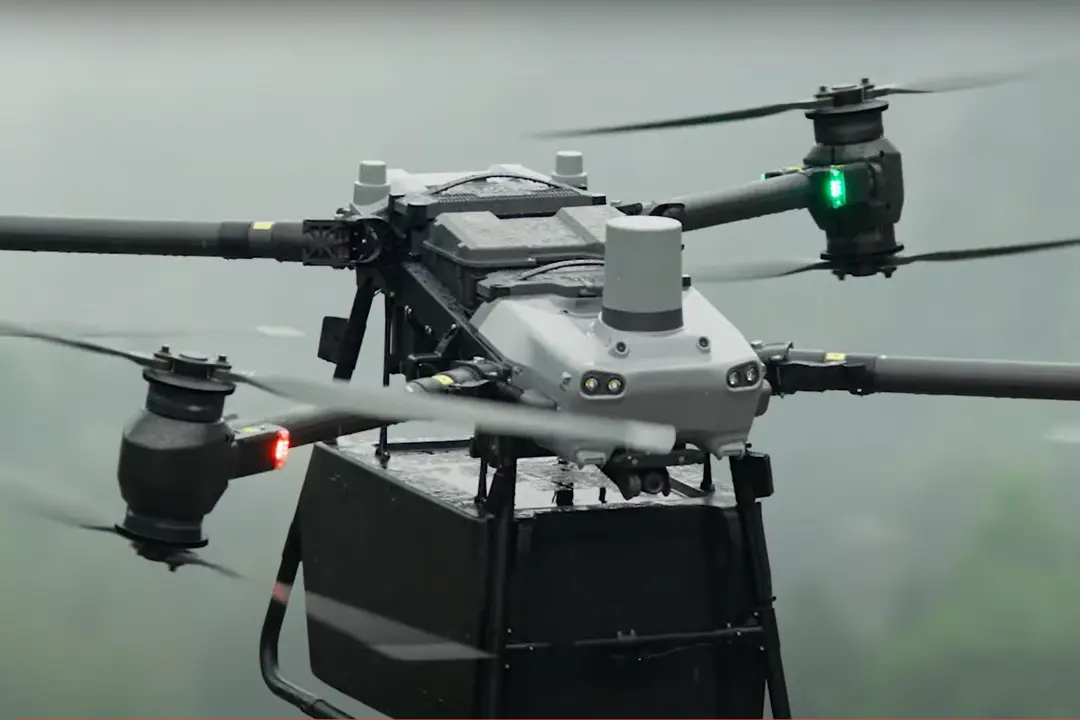
The DJI FlyCart 30 is DJI's first purpose-built delivery drone. It is a heavy-lift multi-rotor designed to carry cargo to places that are slow, costly or risky to reach by road, such as mountain sites, offshore platforms and emergency zones.
DJI announced it for the global market in a press release dated January 10, 2024, titled "DJI's First Delivery Drone Takes Flight Globally".
This explainer covers what the FlyCart 30 is, the specifications DJI publishes, its two delivery modes, how pricing works, the rules that apply to a drone this size, and what it means if you run a delivery operation. If your deliveries still travel mostly by van, our delivery management software covers the ground side of the job.
What the DJI FlyCart 30 is
The FlyCart 30 (DJI shortens it to FC30) is a coaxial, four-axis, eight-blade multi-rotor with carbon fiber propellers, as described in DJI's launch announcement. In plain terms, it has four arms with two stacked rotors on each, which gives it lifting power and some redundancy.
It is not a small parcel drone that drops a shoebox in a backyard. It is closer to a flying utility vehicle for short, difficult legs where a road trip would take hours or a helicopter would be overkill.
DJI positions it for mountain, offshore and emergency rescue transportation. The industries listed on its product page enquiry form include transport, engineering, emergency, energy, public safety and water transport.
Published specifications
These are the headline figures from DJI's own pages. Check the live pages before relying on them, because DJI can update specifications by region.
Payload and range
The FlyCart 30 runs on two batteries as standard, with an emergency single-battery mode.
- Dual-battery mode: a 30 kg payload over up to 16 km, according to the launch announcement.
- Single-battery mode: a 40 kg payload over up to 8 km, also from the launch announcement.
- Without payload, the product page lists a 28 km flight distance in dual-battery mode.
- Maximum flight time at full load is 18 minutes with 30 kg in dual-battery mode and 9 minutes with 40 kg in single-battery mode, per the FlyCart 30 specifications.
- Maximum takeoff weight is 95 kg with cargo at sea level, per the FlyCart 30 specifications.
Speed, weather and altitude
- Maximum horizontal speed is 20 m/s, about 72 km/h, per the FlyCart 30 specifications.
- Wind resistance is up to 12 m/s, the operating temperature range is -20° to 45° C, and the aircraft carries an IP55 rating, according to the FlyCart 30 specifications.
- Standard propellers are rated from 0 to 6,000 m altitude, with flight up to 3,000 m carrying a 30 kg payload, according to the launch announcement.
Batteries and connectivity
- Each DB2000 battery is rated at 1984.4 Wh and weighs approximately 11.3 kg, with a maximum charging power of 5700 W, per the FlyCart 30 specifications.
- DJI's O3 transmission keeps the drone linked to its controller at up to 20 km, as set out in the launch announcement (DJI notes the range figure assumes FCC-compliant conditions). A dual operator mode lets two pilots in different places hand over control with one click.
- The product page also lists 4G enhanced video transmission alongside O3.
Cargo mode and winch mode
The FlyCart 30 delivers in one of two ways.
Cargo mode uses a 70-liter case with weight and center-of-gravity sensors, so the drone can check the load is balanced before it flies, per the launch announcement. This suits sites with a clear, flat landing spot.
Winch mode lowers the load on a 20 m cable that retracts at 0.8 m/s and carries up to 40 kg, according to the launch announcement. It is meant for places where the drone cannot land, such as a slope, a rooftop or a site surrounded by trees. The specifications list winch payloads of 5 to 30 kg with dual batteries and 5 to 40 kg with a single battery.
DJI also describes AR projection to mark the landing point and in-flight attitude adjustment to reduce cargo swing.
Safety features and software
For a drone carrying this much weight, the safety design matters as much as the payload. DJI's FlyCart 30 announcement lists:
- Dual active phased array radar and binocular vision for obstacle sensing, day or night.
- A built-in ADS-B receiver that warns of nearby crewed aircraft.
- Pre-takeoff checks of route and conditions, with audio and visual prompts.
- An integrated parachute, with a lowest deployment height of 60 m and a descent speed of 6 m/s under DJI's stated test conditions, per the launch announcement.
On the software side, DJI Pilot 2 is the app for manual flight, and DJI DeliveryHub handles operation planning, status monitoring, team resource management and data analysis. DeliveryHub can also connect to external cloud platforms.
How much is the DJI FlyCart 30?
DJI does not publish a price. Its FlyCart 30 product page says the product is only available in selected countries and regions, and directs buyers to authorized DJI dealers for details. Pricing is set by those dealers.
When you ask for a quote, get a clear list of what is included: how many battery sets and chargers, whether the cargo case and winch both come with it, and what training, servicing and support are part of the package. Batteries, charging and pilot time often matter as much to running costs as the aircraft itself.
Regulations for heavy delivery drones
Buying the drone is the easy part. Flying it commercially means meeting your aviation regulator's rules, and a drone this heavy sits above the simplest categories almost everywhere.
United States
The FAA's Part 107 rules cover small drones that are less than 55 pounds, which the FlyCart 30 exceeds at its loaded takeoff weight. Commercial package delivery by drone is handled under Part 135 operator certification, and the FAA issues the certificates, exemptions and waivers these operations need, as explained on its package delivery by drone page.
Australia
CASA requires a remotely piloted aircraft operator's certificate (ReOC) to operate as a drone service provider for hire or reward, and pilots working under a ReOC need a remote pilot license (RePL). For drones over 25 kg, the ReOC names the specific manufacturer and model, according to CASA's ReOC guidance. RePL ratings for drones under 150 kg in this heavier class are type specific, per CASA's remote pilot license page.
European Union
EASA places operations in the "specific" category when the drone has a maximum takeoff mass over 25 kg, flies beyond visual line of sight or drops material, and these need an operational authorization from the national aviation authority, as set out on EASA's specific category page.
Rules change, and other countries have their own regimes. Talk to your regulator, or to an operator that already holds the right approvals, before you plan a service around a drone like this.
What it means for delivery operators
For most urban and suburban delivery businesses, the FlyCart 30 does not replace a van. A van carries far more per trip, needs no aviation approvals and goes door to door.
Where it makes sense is the awkward leg: a mine site up a mountain track, supplies to a vessel or platform, a construction site across a river, or relief goods after a road washes out. Our look at how drone delivery affects traditional delivery services covers the broader trade-offs, and the role of drones in last mile delivery looks at where they fit in the final leg.
If you are considering a drone leg, think through the whole chain:
- Crew: certified pilots, plus a second operator at the receiving end if you use dual operator mode.
- Power: heavy batteries, fast chargers and a power supply at the launch site.
- Weather: wind and temperature limits that will ground flights on some days, so you need a road fallback.
- Handover: someone to receive the goods and a way to confirm the delivery happened.
That last point is where drone and ground operations meet. Goods still have to be booked, driven to the launch point and confirmed at the other end. Clear proof of delivery matters just as much when the final leg is flown.
Where drones fit for now
The DJI FlyCart 30 is a serious piece of equipment for a narrow set of jobs. It lifts real payloads over terrain that defeats vehicles, but it comes with licensing, crew and battery demands that put it out of reach as a casual add-on.
For most delivery teams, the bigger gains still come from better planning, tracking and proof on the ground.
If you want to see how that looks on your own routes, request access to Locate2u.

Related Articles
What Is Delivery Management Software?
What delivery management software is, the core features to expect, the benefits for delivery businesses, how to choose a platform and where the market is going.
The Future of Proof of Delivery: Photos and Beyond
How proof of delivery is moving beyond paper signatures to photos, GPS timestamps and AI checks, and how to choose the right POD setup for each risk level.

How Proof of Delivery Beats Porch Pirates
Package theft hits delivery businesses as hard as customers. How proof of delivery, live tracking, safer drop-offs and driver training cut porch piracy losses.