How to Compare Logistics Software: Four Tests, Applied to 12 Platforms

Drafted with AI assistance, edited and fact-checked by Sean Flannery. See our editorial policy.
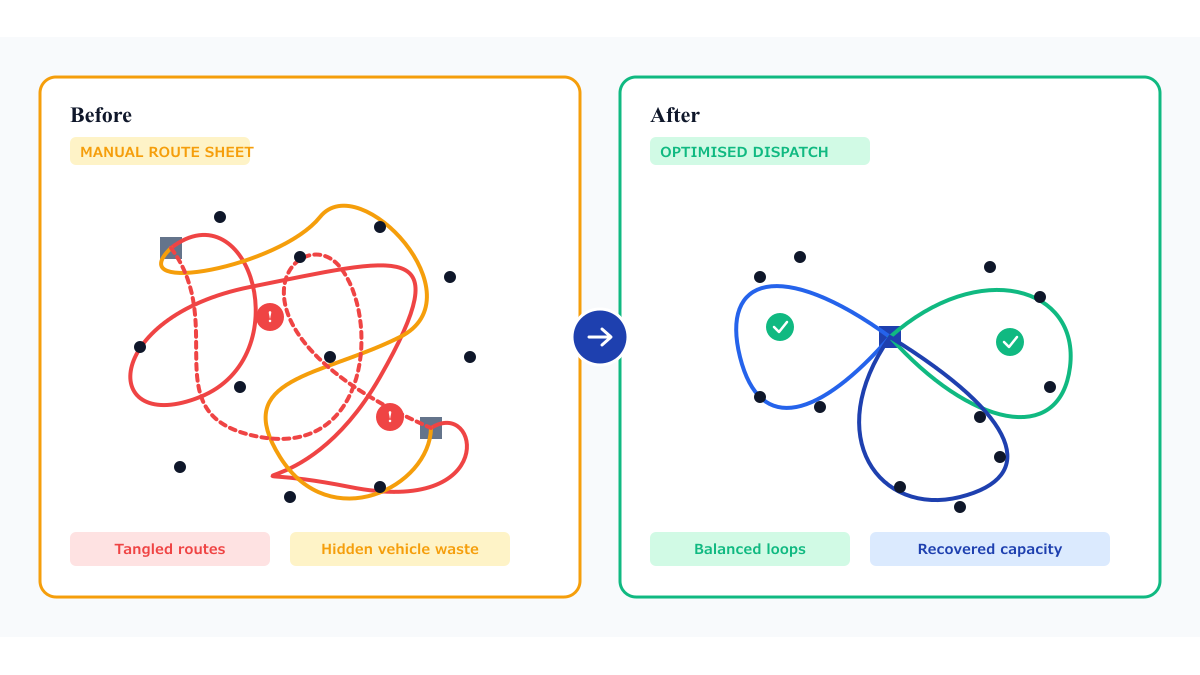
Search for “best logistics software 2026” and you get sponsored lists. They rank platforms on star ratings that nobody can audit, in categories that don't map to how an operator actually decides. The lists are written for clicks. They are not written for the dispatch lead who has to make a six-figure software decision and stand by it for three years.
This piece is the opposite. We benchmark twelve named logistics software platforms across four dimensions that genuinely separate them: scope, operator profile, integration model, and pricing posture. Every claim describes publicly visible positioning, not invented performance numbers. Where a platform's published documentation makes the call easy, we say so. Where it doesn't, we tell you what to ask in the demo.
Locate2u is one of the twelve. We have written this honestly because the dispatch leads who read it can tell when they're being sold to, and because our editorial policy commits us to comparing on verifiable features and pricing only. If a competitor does something well that we don't, we say it. That is the only kind of comparison that survives a procurement review.
The four dimensions that actually separate platforms
Most comparison articles treat features as the primary axis. Features mostly converge. By 2026, every serious platform claims route optimization, driver app, proof of delivery, real-time tracking, and an API. What separates them is how those features fit together and who they fit best.
Scope. Is the platform a point solution that does one thing well (route optimization, or tracking, or proof of delivery), or does it bundle dispatch, routing, tracking, and customer notifications into a single tenant? Point solutions are easier to buy and harder to grow into. Bundled platforms cost more up front and pay back when you stop maintaining four integrations.
Operator profile. Some platforms are built for SMB delivery operations of five to fifty drivers. Others are built for enterprise last-mile orchestration across thousands of stops a day. The capabilities overlap; the pricing, support, and onboarding don't. Buying an enterprise platform for a fifteen-driver operation is one of the most common procurement mistakes we see in the operator community.
Integration model. Three patterns dominate. API-first platforms expect you to wire them into your existing stack (WMS, OMS, e-commerce, accounting). All-in-one platforms expect to be your stack. Hybrid platforms ship as all-in-one but expose APIs for the parts you'd rather replace. The wrong model adds a developer salary to your TCO that nobody scoped.
Pricing posture. Per-driver, per-stop, per-vehicle, flat, or enterprise-negotiated. The pricing model often signals the real operator profile: per-stop pricing favours high-density urban delivery; per-driver favours stable headcount; enterprise quotes favor large-spend predictability and slow procurement.
The twelve, grouped by scope
We've grouped the platforms by the scope they primarily compete on. Within each group, the differentiators are operator profile, integration model, and pricing.
End-to-end delivery operations (SMB through mid-market)
1. Locate2u
Our own delivery management software. All-in-one: route optimization, driver app, live tracking, proof of delivery, customer notifications, and a customer-facing tracking link in one tenant. Operator profile is SMB through mid-market delivery and field service, typically five to two hundred drivers. Integration model is hybrid, the platform works standalone and exposes an API for shops that want to push orders from an existing OMS or WMS. Pricing is a single platform fee based on the functionality you need, published on our pricing page; there is no enterprise-only tier hiding the headline number. We are the right pick when you want a single tenant that covers the whole delivery operation without an integration project, and when published pricing matters during procurement.
2. Onfleet
Public positioning is last-mile delivery management with a strong API-first design philosophy. Onfleet's documentation is unusually thorough for the category, which signals their target operator: teams with engineering capacity who want to embed delivery operations into a broader product. The driver app and dispatch console are solid; the differentiator is how well the platform behaves as a component inside a larger system. Per-task pricing tiers are published; enterprise quoting handles high-volume operators. Right pick when you have a developer team and an existing OMS or shopping platform you'd rather not replace.
3. Track-POD
Positions around proof of delivery and electronic signatures, with full dispatch and tracking layered on top. The platform's heritage in POD shows up in form-design flexibility: custom fields, signature flows, photo proof, and barcode capture are first-class rather than bolted on. Operator profile skews to courier and parcel operations where the POD audit trail is the contractual deliverable. Pricing is per-driver, published. Right pick when proof-of-delivery integrity is what your customers are paying for.
4. Detrack
Publicly positions as real-time delivery tracking and electronic POD, with a strong customer-notification stack. Operator profile is SMB courier and last-mile teams in Asia-Pacific and globally; the platform has a long-running presence in Southeast Asian markets that's worth noting if your operation is regional. Integration model is hybrid; pricing is per-vehicle and published. Right pick when customer-facing tracking experience: SMS, web, branded portals, is the metric your customers care about most.
Enterprise last-mile orchestration
5. Bringg
Positions as a delivery management platform for enterprise retail and shipper operations: the kind of operator who is coordinating thousands of stops across multiple carriers, fleets, and store-as-dock arrangements. The differentiator is multi-fleet orchestration: routing the same order across an internal fleet, a third-party carrier, and a crowdsourced courier based on cost and SLA. Pricing is enterprise-quoted and not published. Right pick when your problem is orchestrating across carriers and fleets rather than optimizing a single fleet's day.
6. FarEye
Enterprise last-mile platform with strong roots in 3PL and retail logistics. Public positioning emphasises route planning, real-time visibility, and customer experience for large shippers. Operator profile is unambiguously enterprise, the platform's value compounds at scale, and procurement assumes a multi-quarter implementation. Integration model is API-rich and configurable; pricing is enterprise-quoted. Right pick when you are buying logistics software as part of an enterprise digital transformation rather than as point operations software.
7. Shipsy
Positions as an end-to-end logistics platform covering first mile, middle mile, and last mile, with particular strength in cross-border and international parcel operations. Operator profile is enterprise shippers and 3PLs with multi-leg shipment flows. The differentiator is breadth across the logistics lifecycle: a single tenant can model pickup, hub-to-hub linehaul, and final delivery without stitching together three systems. Enterprise-quoted pricing. Right pick when middle-mile and customs visibility belong in the same view as last-mile dispatch.
Route optimization point solutions
8. OptimoRoute
A focused route planning and scheduling platform. Public positioning is straightforward: feed orders in, get optimized routes out, dispatch them to drivers. The platform does not try to be a tracking-and-customer-experience layer; it is deliberately narrower than the all-in-one platforms above. Operator profile is SMB through mid-market, especially field service and home delivery. Pricing is per-driver, published. Right pick when route quality is the bottleneck and you already have separate systems for everything downstream.
9. Routific
Another route optimization specialist, with public positioning around simplicity of the planning UI. The platform is often chosen by operators who want a usable browser-based planning tool rather than a heavy dispatch console. Operator profile is small SMB delivery operations; the platform deliberately keeps the surface area small. Pricing is per-vehicle, published. Right pick when the dispatch lead is one person, planning takes thirty minutes a morning, and the operation just needs the math done.
10. SimpliRoute
Route optimization and visibility platform with a strong presence in Latin American markets and growing internationally. Differentiator is the bundled tracking and customer-notification layer on top of the optimization engine, closer to a hybrid than a pure point solution. Pricing is per-vehicle. Right pick when route optimization is the primary need but you want lightweight tracking included without buying a second platform.
Field service and fleet crossover
11. WorkWave
A field service management ecosystem that extends into route operations for delivery-adjacent verticals: pest control, lawn care, cleaning, and service-with-product delivery. The differentiator is depth in field service workflows, quoting, recurring service contracts, customer history, that pure delivery platforms don't carry. Operator profile is service businesses where delivery is one part of the job. Pricing is per-user, enterprise-tiered. Right pick when delivery is part of a service operation, not the operation itself.
12. DispatchTrack
Public positioning is last-mile delivery management for heavy goods, furniture, appliances, and high-touch home delivery. The differentiator is depth in scheduling, customer notification, and proof-of-delivery flows tuned for high-value, low-frequency deliveries where each stop matters disproportionately. Operator profile is retail and 3PLs handling bulky goods or in-home installation. Enterprise-quoted pricing. Right pick when the average stop value is high, the customer expects a two-hour window, and an exception is genuinely expensive.
How to actually use this framework
The most expensive mistake in logistics software procurement is buying for the operation you wish you had instead of the operation you currently run. Enterprise orchestration platforms quote for the customer profile they want to attract; they are not designed for a fifteen-driver operation and the implementation timeline reflects that. Point solutions, conversely, are not designed to grow with you past a certain operational complexity, and the second platform you buy to fill the gaps will not integrate cleanly with the first.
A pragmatic shortlist process looks like this. First, place yourself on the operator profile axis: are you SMB, mid-market, or enterprise? Be honest. Second, decide which scope you actually need: a single tenant that does everything, or a best-of-breed stack. Third, pick the integration model that matches your engineering capacity. If you don't have developers, an API-first platform is a hidden cost. Fourth, demand published pricing. If a vendor's headline number is “contact sales”, your operator profile is being assumed before the demo starts.
From those four answers, the twelve platforms above usually narrow to three candidates. Run those three on a two-week trial against your real operation: same orders, same drivers, same week. The platform that survives that test is the one to buy, regardless of which list it tops or how many stars it has on the comparison sites.
What we did not benchmark
We did not rank these platforms on a single composite score. Composite scores compress operator profile, scope, and pricing into one number, which is exactly the information loss that causes the wrong-tool-for-the-job procurement mistake. We did not include performance benchmarks of routing speed or accuracy because those numbers depend on dataset, fleet size, and constraint configuration in ways that don't transfer between operators. And we did not link to any of the eleven competitors above; our editorial policy commits us to factual comparisons without outbound competitor links, which lets us focus on the positioning that's actually publicly verifiable from their own materials.
If a platform we did not include should be on this list, email [email protected]. The framework above is the part that doesn't age; the twelve platforms named will. We update the list when the category moves.
FAQs
Is this list ranked from best to worst?
No. Ranking logistics platforms across operator profiles produces misleading recommendations. The platforms are grouped by scope so you can find the right group for your operation and then compare within it.
Why does Locate2u appear in its own benchmark?
Because pretending otherwise would be dishonest. Our editorial policy commits us to factual, no-trash comparisons. Removing ourselves from a list of twelve relevant platforms in our own category would tell you less than including ourselves with the same descriptive treatment we apply to everyone else.
How often is this updated?
Substantively, when the category moves: a major platform changes positioning, a new entrant becomes credible, or pricing models shift across the field. We do not bump the “Updated” date on this post for typo fixes or formatting changes; see our editorial policy for our date-modification discipline.
Why no pricing numbers?
Where a platform publishes its pricing, we say so qualitatively (per-driver, per-vehicle, per-stop, enterprise-quoted) so you know what to expect. We do not quote specific dollar figures because they change frequently and any number we wrote down would age within the quarter. The price you actually pay depends on volume, contract length, and feature tier, verify it directly with the vendor's published pricing page.
What if my operation needs more than one of these platforms?
It usually doesn't. The pattern we see is operators running two overlapping platforms because they bought a point solution first and outgrew it. Picking the platform whose scope matches your three-year operational plan, rather than your current month, prevents that outcome.